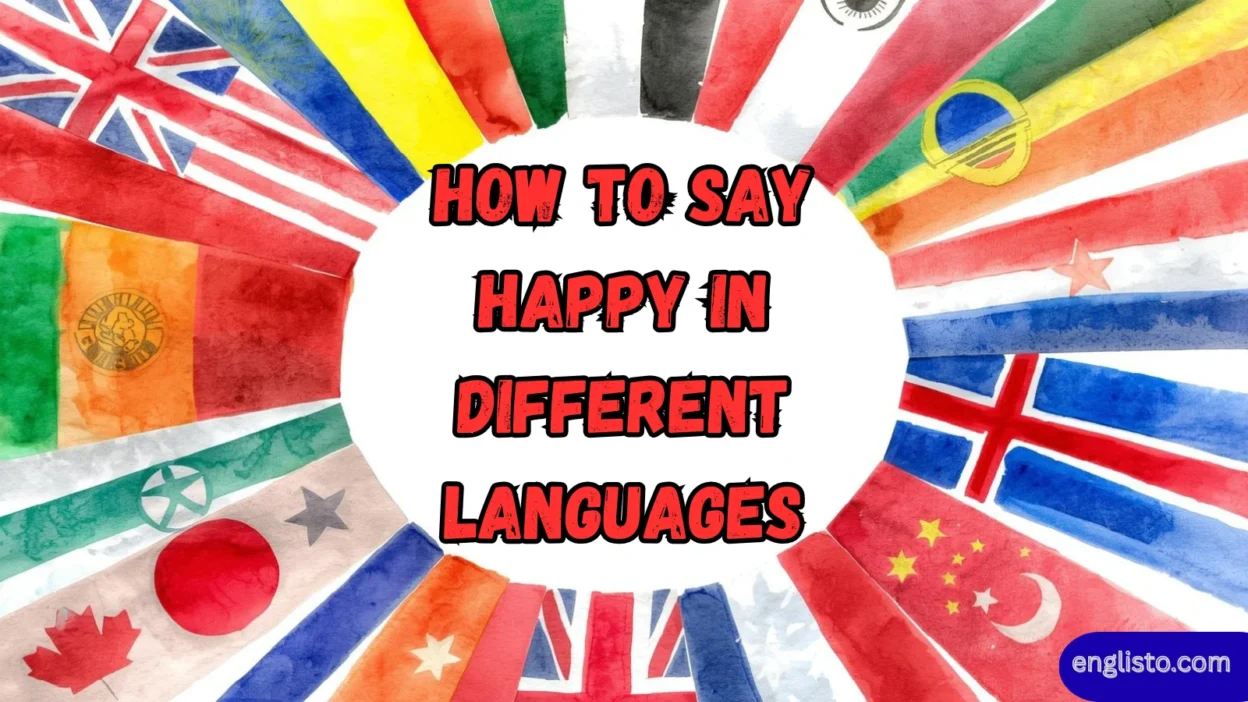
Learning how to say “happy” in different languages is a simple yet powerful way to connect with people around the world. Whether you are traveling, chatting with friends online, or exploring new cultures, knowing how to express happiness in various languages makes communication more meaningful. This guide provides a comprehensive list of 804+ “happy” translations with easy pronunciations so you can use them confidently in real-life situations. Discover how happy translations differ across cultures and make your conversations more vibrant and friendly.
100 Languages: How to Say “Happy”
| Language / Country | Native Phrase | Pronunciation |
| English | Happy | HAP-ee |
| Spanish | Feliz | fe-LEEZ |
| French | Heureux / Heureuse | uh-RUH / uh-RUHZ |
| German | Glücklich | GLUHK-likh |
| Italian | Felice | fe-LEE-che |
| Portuguese | Feliz | fe-LEEZ |
| Dutch | Gelukkig | GE-luk-kikh |
| Russian | Счастливый | schas-LEE-viy |
| Mandarin Chinese | 高兴 | gāo xìng |
| Japanese | 幸せ | shi-a-wa-se |
| Korean | 행복한 | haeng-bok-han |
| Arabic | سعيد | sa-eed |
| Hindi | खुश | khush |
| Bengali | সুখী | shukhi |
| Turkish | Mutlu | moot-loo |
| Greek | Ευτυχισμένος | ef-tee-khee-sme-nos |
| Swedish | Glad | glad |
| Norwegian | Glad | glad |
| Danish | Glad | glad |
| Finnish | Onnellinen | ON-nel-li-nen |
| Polish | Szczęśliwy | shchen-SHLEE-vih |
| Czech | Šťastný | SHTYAST-nee |
| Slovak | Šťastný | SHTYAST-nee |
| Hungarian | Boldog | BOL-dog |
| Romanian | Fericit | fe-ree-CHEET |
| Bulgarian | Щастлив | SHTAS-tliv |
| Serbian | Srećan | SREH-chan |
| Croatian | Sretan | SREH-tan |
| Ukrainian | Щасливий | shchas-LEE-viy |
| Hebrew | שמח | sa-MAY-akh |
| Thai | มีความสุข | mee khwaam sook |
| Vietnamese | Hạnh phúc | hanh fook |
| Indonesian | Bahagia | ba-HA-gi-a |
| Malay | Gembira | GEM-bee-ra |
| Swahili | Furaha | foo-RA-ha |
| Filipino | Masaya | ma-SA-ya |
| Tamil | மகிழ்ச்சி | ma-gi-lchi |
| Telugu | సంతోషంగా | san-to-sha-nga |
| Kannada | ಸಂತೋಷ | san-TO-sha |
| Malayalam | സന്തോഷം | san-TO-sham |
| Marathi | आनंदी | aa-NAN-dee |
| Punjabi | ਖੁਸ਼ | khush |
| Urdu | خوش | khush |
| Pashto | خوشحال | khush-haal |
| Farsi | خوشحال | khosh-haal |
| Lao | ມີຄວາມສຸກ | mee khwam sook |
| Khmer | សប្បាយ | sa-bai |
| Mongolian | Аз жаргалтай | az zhar-gal-tai |
| Nepali | खुशी | khushi |
| Sinhala | සතුට | sa-TOO-ta |
| Albanian | i lumtur | ee loom-toor |
| Bosnian | Sretan | SREH-tan |
| Estonian | Õnnelik | uh-NEL-lik |
| Latvian | Laimīgs | LAI-migs |
| Lithuanian | Laimingas | lai-MING-as |
| Icelandic | Hamingjusamur | ha-MING-yu-sa-mur |
| Maltese | Hieni | HEE-en-ee |
| Georgian | ბედნიერი | bed-NI-er-i |
| Armenian | Սերունդ | se-RUND |
| Azerbaijani | Xoşbəxt | khosh-BEKHT |
| Kazakh | Бақытты | ba-KHYT-tuh |
| Uzbek | Baxtli | bakht-LEE |
| Kyrgyz | Бакыттуу | ba-KIT-too |
| Tajik | Хушбахт | khush-BAHT |
| Turkmen | Bagtyýar | bag-TYAR |
| Pashto | خوشحال | khush-haal |
| Sindhi | خوش | khush |
| Somali | Faraxsan | fa-RAK-san |
| Amharic | ደስተኛ | des-te-nya |
| Yoruba | Ayọ | a-YO |
| Igbo | Obi ụtọ | o-bee oo-TOO |
| Hausa | Farin ciki | fa-rin chi-kee |
| Zulu | Jabule | ja-BOO-le |
| Xhosa | Nandipha | nan-DEE-pha |
| Maori | Hari | HA-ree |
| Samoan | Fiafia | fee-AH-fee-ah |
| Tongan | Fiefia | FEE-eh-fee-ah |
| Tahitian | Hau’ofa | hau-OH-fa |
| Hawaiian | Hau’oli | hau-OH-lee |
| Malagasy | Faly | FAH-lee |
| Haitian Creole | Kontan | kon-TAHN |
| Luxembourgish | Glécklech | GLEK-lekh |
| Breton | Laouen | LAH-wen |
| Welsh | Hapus | HAH-pus |
| Scottish Gaelic | Toilichte | TOY-lik-ta |
| Irish | Sona | SOH-na |
| Basque | Pozik | PO-zik |
| Catalan | Feliç | fe-LEETCH |
| Galician | Feliz | fe-LEEZ |
| Corsican | Felice | fe-LEE-che |
| Sardinian | Felice | fe-LEE-che |
| Occitan | Felize | fe-LEE-ze |
| Ladino | Feliz | fe-LEEZ |
| Breton | Laouen | LAH-wen |
| Luxembourgish | Glécklech | GLEK-lekh |
| Frisian | Lokkich | LOH-kikh |
| Faroese | Gleðiligur | GLE-thi-li-gur |
| Greenlandic | Asavakkit | a-sa-VAH-kit |
Conclusion
Learning how to say happy in different languages opens doors to global communication, cultural appreciation, and meaningful interactions. With this guide, you now have a handy reference for happy translations in 100 languages, along with proper pronunciations and usage examples. Whether for travel, study, or conversation, expressing happiness in someone’s native language instantly builds connection and warmth.
FAQs
- How do I pronounce “happy” in Mandarin?
The native phrase is 高兴 (gāo xìng), pronounced gao shing. - Is there a difference between male and female forms of “happy” in other languages?
Yes, languages like French and Hebrew have gendered forms: heureux (male), heureuse (female). - Can I use these “happy” phrases in everyday conversation?
Absolutely! Most of these are standard expressions suitable for greetings, compliments, or personal feelings. - Which language has the shortest word for “happy”?
Languages like Thai (สุข) and Swahili (furaha) have short, easy-to-pronounce words.
Why learn “happy” in multiple languages?
Knowing this phrase allows you to spread positivity, connect cross-culturally, and make travel or online interactions more friendly.